
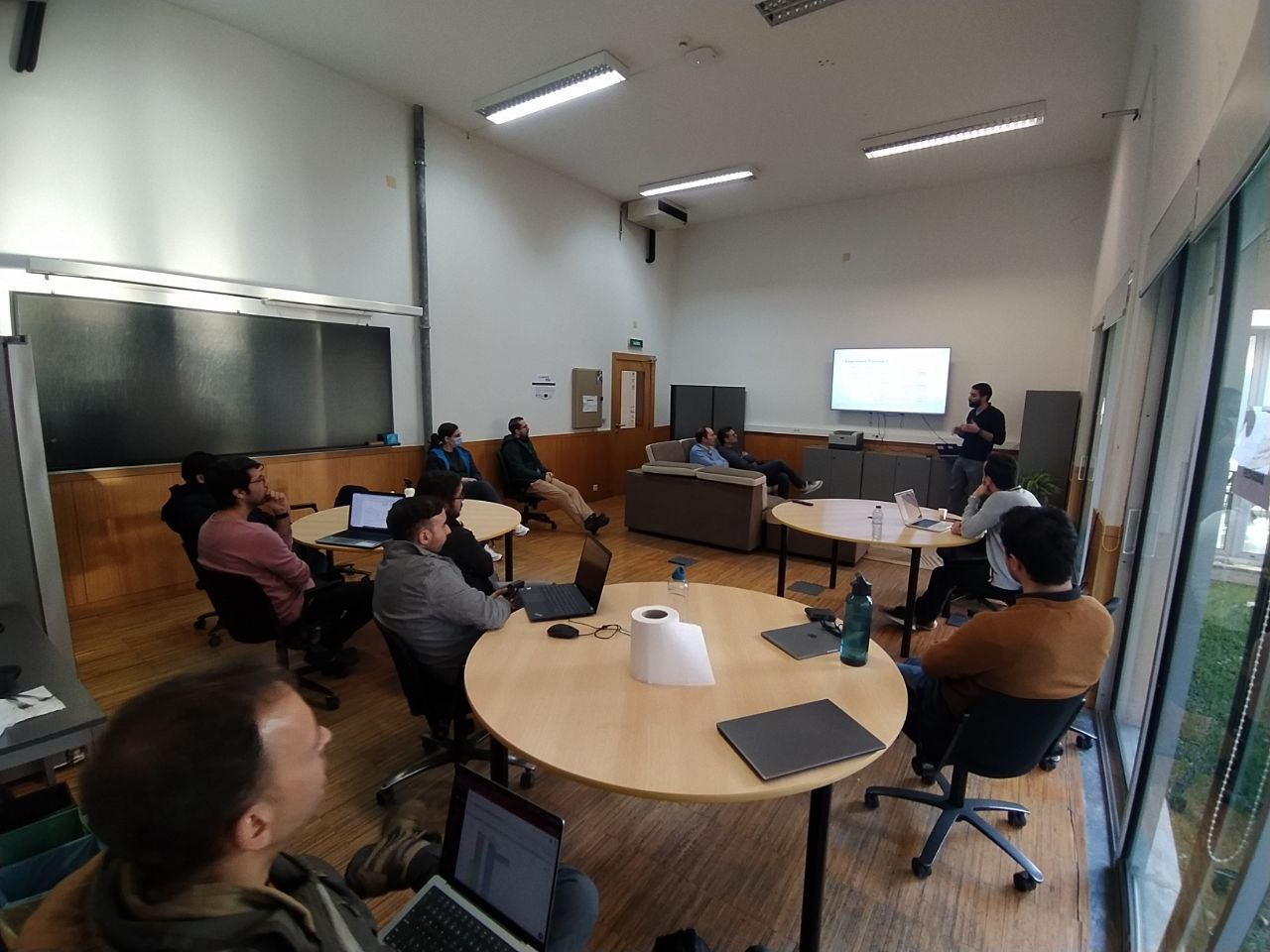
11th of January at 16h00, José Flora and Nuno Seixas will give two short presentations, to promote discussion on two relevant ongoing or disruptive topics. Afterwards, there will be a social gathering where everyone can talk freely on whatever subjects they like.
Location: G4.1
José Flora – “Dataset for Intrusion Detection in Container-based Microservice Systems”
Bio
José Flora is a PhD student of the PhD in Informatics Engineering at the University of Coimbra where he is, since 2017, a researcher with the Centre for Informatics and Systems. He has completed his Masters in Informatics Security in 2019 and his Bachelor’s degree in Informatics Engineering in 2017 at the University of Coimbra. He has participated as Student Researcher in 4 projects, namely H2020: ATMOSPHERE; METRICS and TalkConnect; and CMU-PT AIDA. His expertise includes testing techniques, fault injection, vulnerability injection and benchmarking, applied in the context of multi-tenant cloud and virtualized environments, containers platforms and micro service architectures. His PhD thesis is focused on the security of microservice-based systems, with emphasis on intrusion detection and intrusion tolerance.
Abstract
Microservices are nowadays the predominant architecture for cloud-based applications. Serving millions of customers daily, it is of utmost importance to secure these systems. Intrusion detection is a widely used technique that is now being used in microservices to build behavior profiles and report anomalies during runtime as possible attacks. However, its effectiveness is far from clear, as existing evaluations use datasets reduced in size and limited in representativeness, mainly due to the special nature of microservices, which are ephemeral and highly scalable. We present a comprehensive dataset for microservices intrusion detection based on host data. We use two different well-accepted and representative microservice-based applications, subjected to rich and diverse workloads. We use representative attacks that target real vulnerabilities across different layers of the infrastructure: the web server supporting the service, the container engine, and the host machine OS. The applications are deployed into a Kubernetes cluster, currently an industry de facto standard. During runtime, we collect for each microservice the system calls and their parameters. The datasets will be available to the community both to use and to contribute: source code and close to 5TB of data.
Nuno Seixas – “An Integrated Maturity Model for modern software development: addressing Security, Artificial Intelligence and Governance in DevOps”
Bio
Nuno Seixas has been working in the software engineering industry since 2004. Having started his career as a researcher in CISUC, part of Medical Informatics research team, moved to commercial software development teams, where he took different roles, from software engineer to project manager. Lately, has been working in optimizing software development operations, introducing consistent processes that would improve the organization’s performance.Has a Master degree in Software Engineering from Carnegie Mellon University and University of Coimbra and has been also involved in teaching Software Engineering classes for both undergraduate and graduate courses, as an Invited Professor at University of Coimbra.
Abstract
While software is becoming more present in every business area, new technologies and needs are being added. In these new trends, we can identify three that have a relevant importance. First, the introduction of Artificial Intelligence techniques, second, the growing importance of cybersecurity and third, the need for assuring compliance for using software in highly regulated environments. The introduction of these new trends demands support from software engineering methods, making sure that organizations are able to produce software in a consistent and solid way. For that, we believe that there should be an integrated maturity model that can help to identify the current state but also, to help define the next steps. Therefore, we propose to produce an integrated maturity model that can address cybersecurity and Artificial Intelligence on software created for regulated environments.